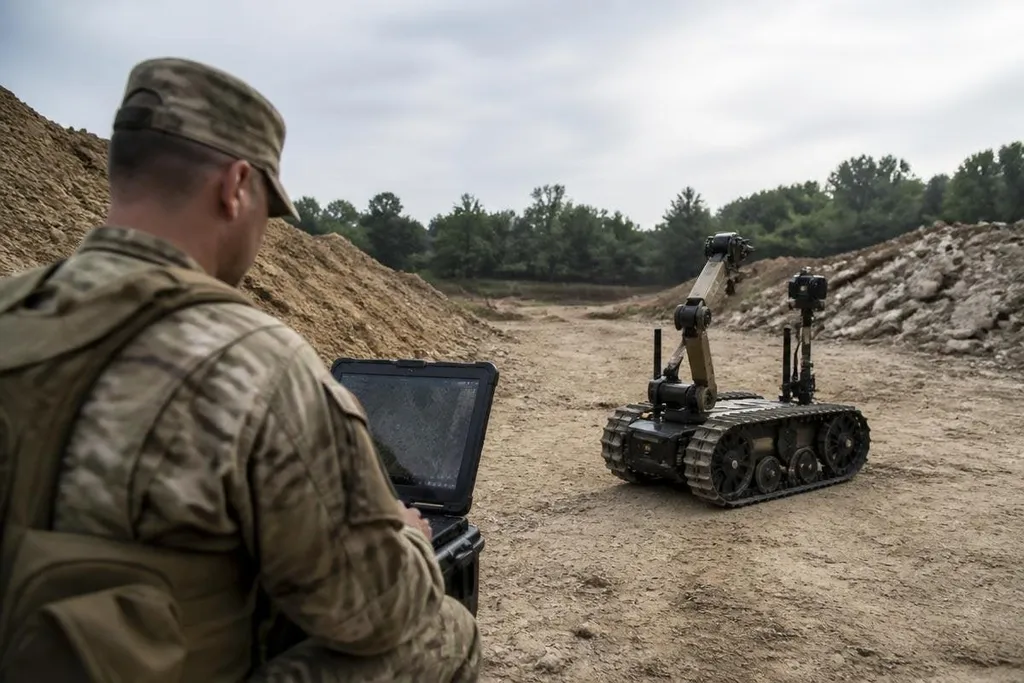
Military robots are moving toward work that keeps people away from danger, but autonomy alone won’t make that work safe or useful. The systems that matter will be judged by how well people can control them when sensors fail, links drop, or the ground changes.
Quick read
- Human operators still need a clear way to approve, pause, and stop machine actions.
- Ground, air, and maritime robots face different limits from batteries, radios, weather, and terrain.
- Procurement teams should test the whole system, not a short video of one successful task.
The work is broader than armed robots
Military robotics includes small aerial drones, unmanned ground vehicles, underwater systems, and machines that carry supplies or inspect damaged areas. Each type has a different job, so one autonomy claim tells you very little by itself.
A drone that follows a route across open ground faces fewer problems than a ground vehicle moving through rubble. A machine that carries a radio relay has a different test from one that moves medical supplies. The useful question is always tied to the task.
That task should be written in plain terms. Move a load, watch a road, map a building, find a damaged vehicle, or carry a sensor. The buyer can then check whether the robot completed the work without constant remote control.
Autonomy needs a clear boundary
Autonomy means a robot can sense its surroundings, choose from set actions, and carry out some steps without a person guiding every motion. It doesn’t mean the machine understands the whole situation.
A system may avoid obstacles while missing a person, a new barrier, or a change in the route. GPS can become unreliable.
A camera can lose detail in smoke, dust, darkness, or glare. Radio links can also weaken when the robot moves behind buildings or terrain.
That is why the operator’s role matters. The control station should show what the robot sees, what it plans to do, and why it stopped. A person should be able to pause the machine without working through several menus or waiting for a remote server.
The same rule applies to armed systems. Any decision to use force needs human approval under the rules set by the military using the system. A robot that moves on its own is one thing; a robot that selects and attacks a target is a far higher bar.
The test is the whole system
One machine can work well in a quiet test area and still fail during field use. The useful test includes the robot, its batteries, its control software, its radio link, and the people who operate it.
For each trial, the buyer should record the task, the weather, the terrain, the number of operator actions, and the reason for every stop. Those details show whether the machine did the work or whether a person quietly corrected it throughout the run.
A military robot trial needs a report that names the mission, machine, operator, and failure case. Robot24.com can put those details beside claims about autonomous movement, so the buyer can judge the run before asking how the system behaves after a fault.
The buyer should also ask what happens after a fault. Can the robot return to a safe position? Does it stop in place? Can an operator take control when the normal link fails? A system without clear answers creates extra work for the people meant to rely on it.
What procurement teams should check
A practical review can start with these points:
- Name the task: Set one job with a clear pass or fail result.
- Measure operator load: Count every remote command needed during the run.
- Test broken links: Record the robot’s action when communication stops.
- Repeat bad conditions: Include darkness, dust, slopes, clutter, and blocked routes when they match the planned use.
- Check recovery: Confirm how the system stops, returns, or waits after a fault.
This list also exposes a common mistake. A robot may finish a route while consuming so much operator attention that the task gains little. The machine has moved, but the unit has not reduced risk or workload.
The next purchase should reward restraint
Military buyers will keep seeing systems that promise more autonomy. I'd judge them by the quality of their failure behavior first, because a machine that stops clearly is easier to trust than one that keeps moving without a useful explanation.
New military robots will earn their place through repeated tests in the conditions where people need them. Until a supplier can show those logs, the sensible purchase is the robot with a defined task, a visible control path, and a known response when the link goes quiet.